
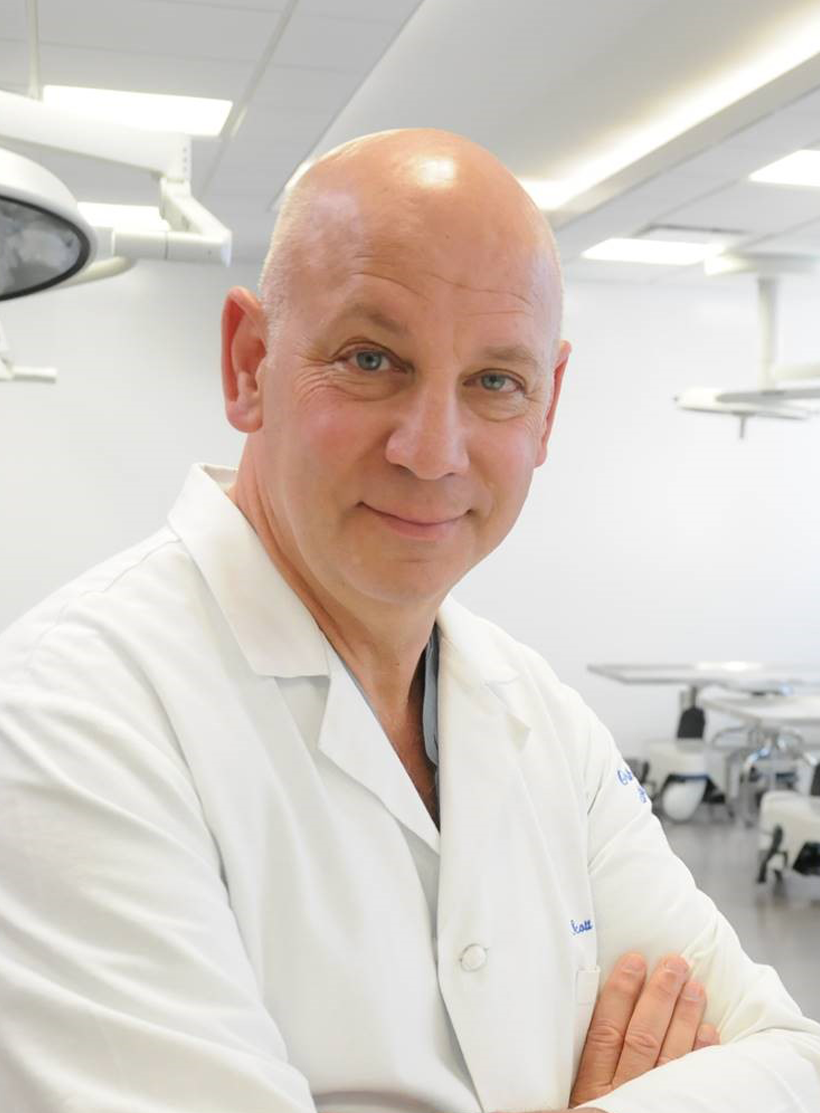
Professor Levin, what originally inspired you to pursue a career in medicine?
When I was a child, I heard many stories about my grandfather, who was in France during World War I, taking care of soldiers returning from battle. That was the period when Sir Harold Gillies, the father of plastic surgery, started to reconstruct the faces of war-injured soldiers. These family stories about my grandfather really resonated with me. In school, I was good at science and interested in dissecting frogs, so I thought: Okay, I’ll try to become a doctor. I was a premed student at Duke University and put myself through school by working as an orderly — mopping emergency room floors and wheeling patients around on stretchers. I applied to medical school and didn’t get in the first time around, which was obviously disappointing. I wound up going to the British West Indies for the first two years of medical school, then transferred to Temple University in Philadelphia and got my MD. It took me a little longer, but once I got into medical school, I never looked back.
What drew you to complete training in both orthopaedic surgery and in plastic surgery?
I completed training in general and thoracic surgery for two years, followed by four years of orthopaedic surgery and a hand fellowship in Louisville, Kentucky. In 1988, I spent some time in Switzerland. During my time in Bern, I got to meet Professor Reinhold Ganz, who was working closely with Professor Christian Gerber. Dr. Jeffrey Mast had also just been in Bern with Reinhold Ganz. This is where the orthoplastic concept, the integration of orthopaedic and plastic surgery, began. The time in Switzerland really opened my eyes to modern thinking about limb salvage and limb reconstruction. Moreover, it taught me to think differently — to approach problems with a new vision. Since my time in Switzerland, I have had a foot in both specialties and have helped to develop the principles and practices of orthopaedic and plastic surgery as applied to surgical problems. I have been an orthoplastic traumatologist for 35 years now, focusing on limb salvage and limb reconstruction, with a strong emphasis on reconstructive microsurgery.
In a 2020 interview, you quoted your mentor, J. Leonard Goldner, MD, who said: "Medicine is a lifestyle. It's not a vocation." Could you please elaborate on that?
Let me preface this by saying that I’m a baby boomer, meaning that I grew up with different expectations and values than younger generations. Back in the day, there was no duty hour restriction. We’d simply get home when the work was done, then go back to work at five in the morning. Medicine is not 9–5 — there’s no start and stop, especially in reconstructive and trauma surgery. This may be detrimental to a marriage or family life, but medicine is a privilege, a calling. I live my profession every day. I’m always available to my colleagues and patients, because continuity in care is very important. When Professor Christian Gerber retired, he spoke of his guiding “Pyramid”, which translates to: The patient and excellence in care delivery always come first. This is an absolute value we need to have in medicine that can never be challenged, that should be our North Star in everything we do.
WIth your long tenure in health system leadership, you have witnessed many structural changes to the US healthcare system. What gives you concern — or hope — for the future?
The obvious current crisis is the restriction on funding for research, which is a fundamental crossroads to advancing healthcare in general. The burden of the uninsured and the global healthcare crisis in places like sub-Saharan Africa also concern me greatly, but that’s obviously not something I can fix. Then there are the regulations concerning trainees with respect to restricting their training hours. Malcolm Gladwell said you need 10,000 hours to develop a skill — in my view, limiting education in clinics, in the OR, is detrimental. What I’m optimistic about is that we’ll always find the diamonds: those who will go beyond their capabilities, who want to pursue challenging aspects of surgery like trauma. We have to continue to foster these people. Over the years, I’ve trained over 500 fellows, and I know that they are doing good work and will perpetuate the same values. Times may change, the culture may change, but our inherent values must stay. Once we start compromising our values, we’re in deep trouble.
As a clinician, what do you consider the main draw of our "reducing complexity" concept?
Generally speaking, all advances in medicine are made by taking an unsolved problem and solving it, or by taking a common problem and approaching it with a new lens. “Think different,” as the late Steve Jobs said. In that sense, I truly believe that Bonebridge is a disruptive innovator. Nothing is more frustrating than complexity in the OR — fifteen different trays on the table, or ten sales reps in the room, only to place a screw through a plate. Plates and screws have been around since the fifties, based on the founding fathers of the AO — so in a sense, Bonebridge is a variation on a theme. The real innovation is that by simplifying implants, we are trying to dramatically increase value in healthcare. Every healthcare system anywhere in the world is looking to maximize value — through cost containment, maximizing efficiency, decreasing complexity, and making things reproduceable.
Do you think the US market is ready to embrace simplified trauma solutions? Or is that a mindset shift that still needs to happen?
Unfortunately, some of our colleagues are going to be hard to shift around. Bonebridge competes in a very established market with established competitors, and it’s a monumental effort to get our foot in the door and change hearts and minds. The great Canadian hockey player Wayne Gretzky once said: “I skate to where the puck is going to be, not where it has been.” In the same sense, Bonebridge has to anticipate what the needs will be — where health economists and traumatologists are going — and we have to get there before anyone else.
Back in 2023, Bonebridge was just starting its business in the US. What motivated you to become a board member at that point?
I was generally open to being appointed to a board. However, I wanted to make sure it would be with a company where I could bring in my experience and have an actual impact. I have had a very meaningful relationship with Professor Christian Gerber and my other Swiss colleagues since my time in Switzerland in 1988, and the fact that he asked me to be on the board was one of the greatest honors of my career. When I met Dr. Christof Gerber, the CEO, I was also very impressed with his leadership. Serving as a member of the board has really brought me back to my roots of “thinking differently”. I have always been on a quest for new knowledge that could impact patient treatment, which is exactly what Bonebridge stands for.
What advice would you give orthopaedic residents starting out in the field today?
There’s a quote by the late American football coach Vince Lombardi that I like. It goes: “If we chase perfection, we can catch excellence.” In a similar vein, Sir William Osler, one of the most important figures in the founding of modern medicine, said: “The key to success in medicine are two words: hard work.” There’s not one successful person who didn’t work hard. I guess that would be my advice: work hard, always be honest, and never compromise patient care.
On a more personal note: Your wife Helga is originally from Germany, and you have visited Europe — and Switzerland — numerous time. What are some of the things you particularly enjoy when you spend time here?
I feel very much at home in the German-speaking part of Europe, and I always enjoy spending time in the wonderful city of Zurich. It has such a high standard of living, and the food there is fantastic. Speaking of which: My wife calls me a “wurst freak” — my favorite place to go back to in Zurich is the Sternen Grill for a great bratwurst!
L. Scott Levin, MD, FACS, FAOA, FAMSE, is a world-renowned physician-scientist with a focus on limb salvage surgery, surgery of the hand, and microsurgery. He is the Paul B. Magnuson Professor of Bone and Joint Surgery, Professor of Surgery (Plastic Surgery) and the Chairman Emeritus of the Department of Orthopaedic Surgery at Perelman School of Medicine at the University of Pennsylvania, PA, USA.